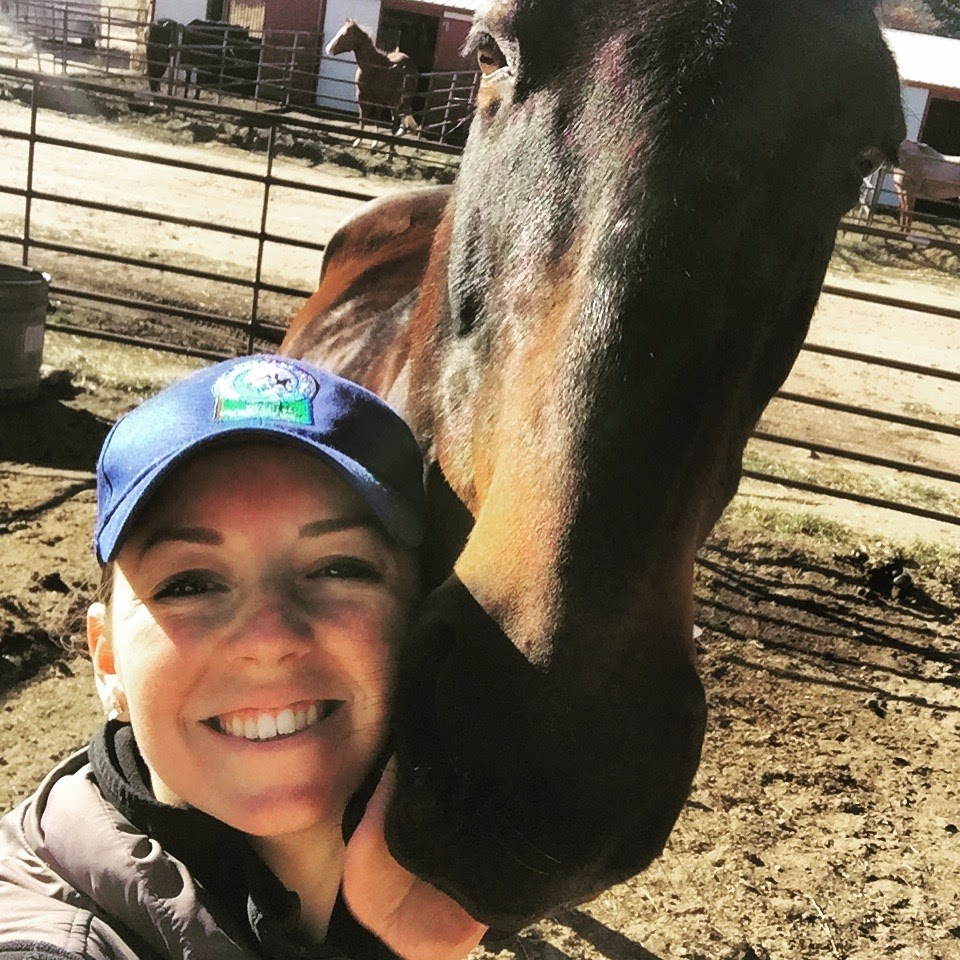
For 20 years, I have never gone more than a few weeks without getting on the back of a horse. Until three years ago, both my professional and personal life revolved around horses. I tried other activities and hobbies as a kid, but taking them up seriously would have required giving up barn time and that was not something I was ever interested in doing.
It’s hard to imagine that I have done anything for two decades. Almost equally as hard to imagine that I’ve all but given it up recently.
In the last three months, I have ridden a horse one time. It was for fifteen minutes. I walked around briefly and then rushed back to the city for a job in an office.
Either subconsciously or consciously, I’ve been slowly working toward this moment in my life for the last four years. After a lifetime spent focused so singularly on one (insanely time- and money-consuming) activity, I think a little part of me knew even back then that it was time to figure out who I was outside the horse world.
Horses have always been my safety net. It’s a sport where you can simultaneously be alone and not lonely. You’re supposed to be by yourself when you’re on your horse, and it’s not a team sport. Plus, if you’re painfully shy and don’t know what to talk about with other kids, you can all just talk about your horses for hours on end.
I would spend hours and hours with whatever horse I was taking lessons on, and that time only increased exponentially once I got my own horse. When I was stressed out, I went to the barn. When I didn’t know what to do with myself, I went to the barn. When I graduated from college and REALLY didn’t know what to do with myself, I retreated to the barn.
I did whatever work the barn manager would give me, before deciding I would just keep working in a barn forever. I took new jobs at new barns, drove in the dark to start work at sunrise, spent my work day in the horse world bubble, and ended it with the sun setting as I squeezed in time with my own horse each night.
Then, I got kicked by a horse at work one day.
My body started telling me something that I think my mind had been trying to get me to admit for a while. I could not stay in the barn. I loved it intensely. But this was not my final destination.
So I took one baby step away. I started a new career in PR….at an agency with exclusively equestrian clients.
I spent my winters in Florida and worked at competitions that I had only dreamed of attending, much less going behind the scenes of. I worked from home when I wasn’t traveling and spent my days either writing about people riding horses or riding a horse myself.
But there was still a nagging feeling that I hadn’t quite found my place.
I wanted to experience the world outside of horses, to have a schedule completely free of any four-legged obligations. To be able to maintain friendships with people not on my insane nomadic rotation of places to live and weekends to work. To have a “normal” life.
Moving to Colorado was my first big step. It’s not a place known for horses like my native state of Maryland. More horses here have jobs working on ranches instead of jumping over painted sticks.
But I couldn’t truly duck and run. I own a horse, after all.
My horse Lizzie is the most complicated relationship I’ve ever known. I love her more deeply than I can describe, but I simultaneously felt strangled by her needs and expenses. I feared I’d never get to know life without Lizzie, for better or for worse.
So I handed over the reins. Literally. I still own her technically speaking, but her everyday needs are taken care of by the girls who lease her.
She is not really mine anymore. She really belongs to those two girls who ride her, take care of her, and fawn over her every day like I used to do. I tell myself I’m not a stranger to her, but I’m not actually sure. Three years after moving her here, most of the time I’m just the lady that comes by when she’s sick or injured, or just to give her some peppermints and leave.
It’s not that I haven’t been welcome to come see her and be a part of her life. I’ve willingly distanced myself, deciding instead to chase outdoor adventures of another variety. It’s been an odd juxtaposition to feel free to figure out who I am and what I like to do outside of horses, and then feel a wave of guilt or sadness for the passion that once dictated my entire life.
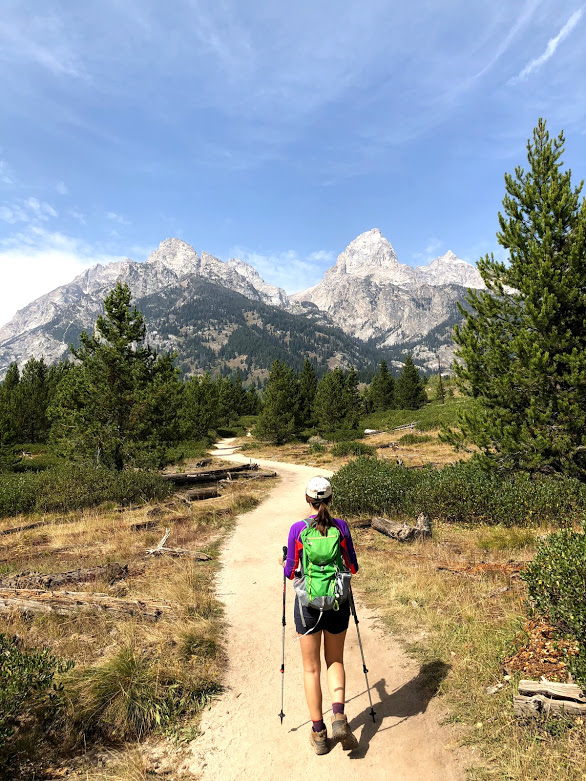
But if I had not taken this break over the last several years, I wouldn’t have found other passions, and friendships, and hobbies. I wouldn’t have started running, or hiking, or explored so much of Colorado. I wouldn’t have started this blog. The person I’m now marrying wouldn’t have stayed in a relationship with me if I had continued to let horses be the only thing I truly loved.
My world no longer revolves around the barn. I’m still not sure I have the balance of horse time in my life just right, and I know it will change again as life goes on. My heart and life are full of many passions and people now, and most importantly I learned how to deal with my feelings and insecurities instead of fleeing for Lizzie’s back and an empty field.
This break has been painful, and confusing, and freeing, and amazing. It has led me to grow as a person, to develop an informed worldview, to see parts of the world that don’t have barns or horse shows. Horses are ingrained deep within me, but now they aren’t the only thing there.
I was ridiculously nervous before going on my last trail run, to the point that I was making myself nauseous. I hadn’t run whatsoever in a few weeks, and the last time I’d hit a trail was over a month ago. I was worried about running “well,” or slowing Billy down, or having to hike the whole time.
With “bikini body” season in full swing, I think it’s easy to get swept up in feelings of not being enough.
Of not being fast enough. In shape enough. Muscular enough. Fit enough.
And once the negative self-talk starts, it’s easy for me to forget why I’m out there in the first place. Not to get killer legs. Not to get skinny. Not to get tan. All of those things may (or may not, depending on your body) happen, but it’s not why I run.
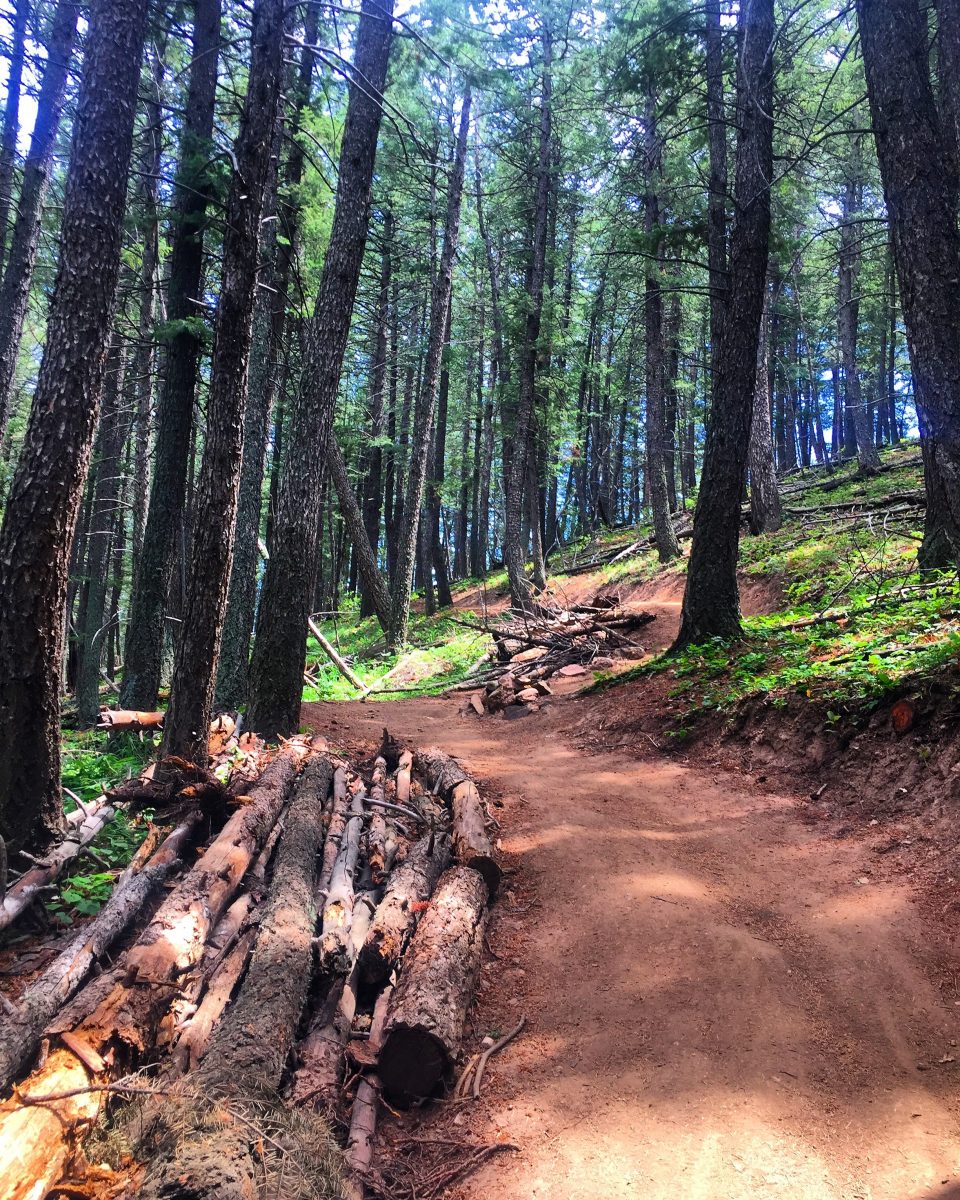
And I don’t just run around my neighborhood anymore. I specifically choose to run on trails. Because I am lucky enough to live in a place where people from around the world come on vacation. I can drive 25 minutes and be in a stunningly beautiful place to go for a run for as long as I would like without having to worry about seeing a single car or stoplight.
Back on the trail, I realized 20 minutes in that I hadn’t looked up once. I was head down, staring at my feet, feeling taunted by Map My Run chirping out that I was doing a blistering 18-minute-per-mile pace. I kept apologizing to Billy that I was slowing us down, and the only thing I could focus on was catching my breath ASAP so I could start running again.
Because God forbid I just stop and enjoy the view, right?
“I’m not in any hurry. I’m here to spend time with you in a beautiful place.”
Billy’s words suddenly resonated with me because I remembered saying almost the exact same thing to one of my good friends when she was bringing up the rear on a group hike. That day, I literally could not care what pace we were going. I just wanted to hang out with my girlfriends, enjoy time outside, and get a little sweaty.
Billy’s tone also revealed that all my negative self-talk wasn’t just getting me down. Listening to me beat myself up about my pace, or lack thereof, was actually much more miserable for him than me running slowly.
I’d like to say this mini revelation was all it took to turn my view around that day, but there was one more tiny voice that piped up.
“Distance: two miles. Pace: 13 minutes.”
By mile three, my pace was hovering around 12 minutes.
I was also going downhill at this point in time, which does wonders for the psyche, but instead of taking MapMyRun’s updates as blaring announcements of how slow of a runner I am, I remembered where I started.
Usually, MapMyRun feels like a not-so-gentle reminder of how below-average my times are (when I’m comparing myself to professional athletes, as any reasonable person does). But for some reason that day she was a wake-up call, shouting that I’m improving.
At the beginning of 2017, I was run/walking a 15-minute mile at best. Like on a REALLY GOOD day, when I ran downhill a lot, I would hit 15-minutes per mile. But now, on a day that I hadn’t run in weeks, that I was feeling super shitty about myself, I was hitting a 12-minute pace.
(I don’t think I’m actually getting any faster, I’m just walking shorter amounts of time during each run that I go on. Plus, I feel like I’m running less and less like an elephant each time.)
When you don’t have the hard numbers to back it up, it’s easy to say “Oh, I’m not actually getting any better at this. I’ll just always suck.” And sometimes having all that data assigned to your physical fitness is really stressful. But if you don’t let it suck the fun out of what you’re doing, you never know when that little robot voice may turn into that little reminder that you are, in fact, crushing it.
You may be thinking to yourself, “but Laura, you can’t even run a 10k. Why would you need a hydration vest?”
Because running is really hard and I like snacks.
For reference, when I bought my first vest, I was run-hiking longer than a 5k in the summertime before I felt like I needed to be able to bring water with me. However, no matter what distance you’re running, being able to bring keys and a phone is handy (or rather, hands-free!).
But how do you begin sorting through all the options?
Soft flask bottles or reservoir?
The first thing to decide is how you want to carry your hydration. I prefer a reservoir because I can bring more water (I get really really thirsty when I run). I also don’t like having to take bottles in and out of pockets every time I want a drink. The newer flasks with long straws out of the top technically solve this problem, but I don’t like the giant straws flopping around.
Some people don’t like using a reservoir because of the sloshing sound it can make. This has never bothered me, and you can always empty out the extra air in the reservoir before you start running to decrease this. People also don’t like the tube/hose from the reservoir flopping around when they run.
Bottles have the advantage of allowing you to bring two different types of drinks on your run. For example, one bottle of electrolytes and one bottle of regular water.
Regardless of your preference, most packs come with a reservoir or bottles, so if you don’t already have any, don’t worry about having to buy something in addition to your (already expensive) vest.
What do I look for in a vest?
The most important thing is fit and overall comfort wearing the vest.
I also prioritized the ability to store a 1.5-liter reservoir of water. For my first vest, I wasn’t looking for much additional storage since I only wanted to bring my phone, car keys, and maybe a pack of gummies. When I started training for a half marathon in the winter, I looked for a vest that could store hiking/trekking poles and had more storage for extra layers.
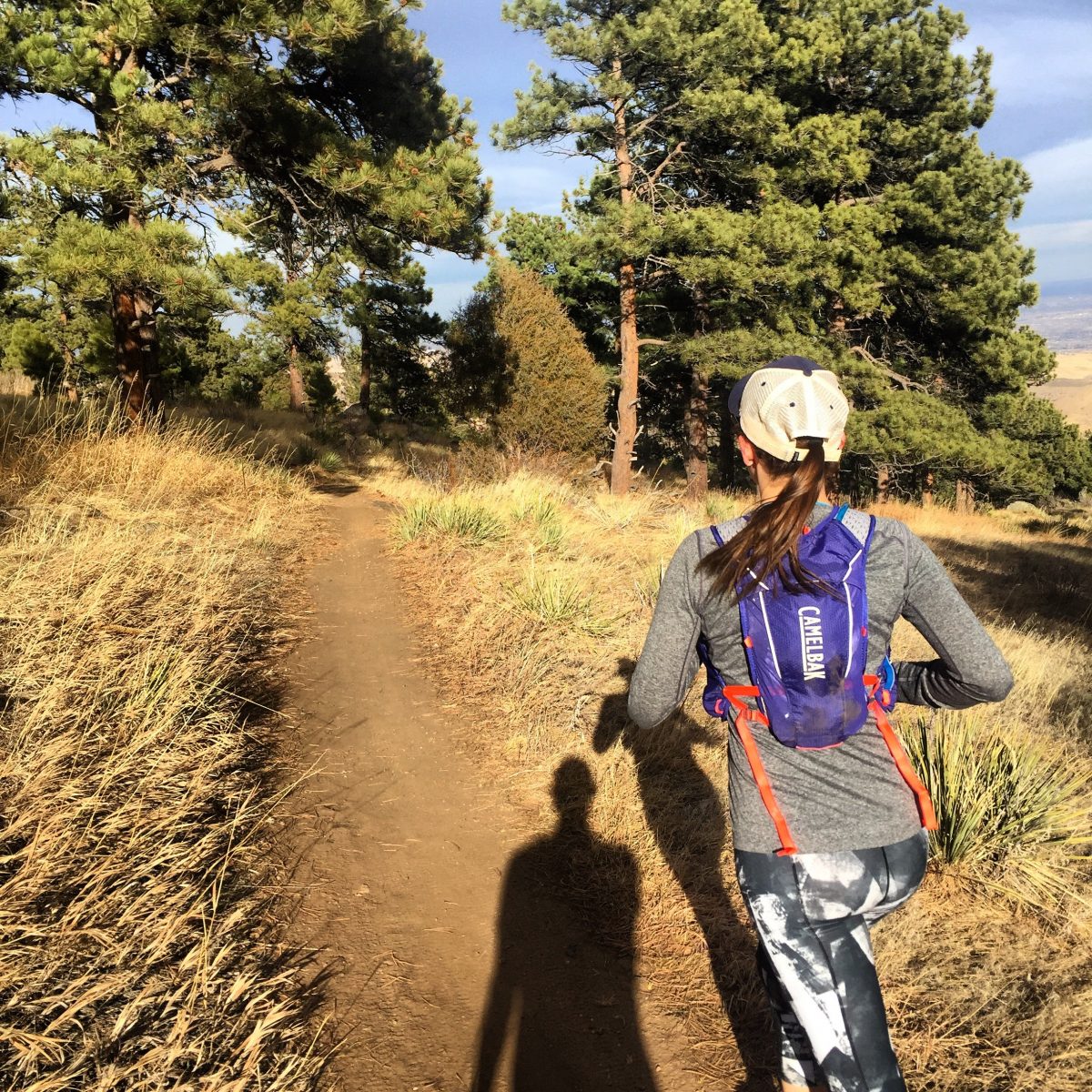
My very first vest was a Camelbak Circuit, which is an excellent beginner’s hydration vest. My second vest for longer runs (for me, more than an hour) is the Osprey Dyna 6.
Since buying both vests, I’ve realized the Osprey vest feels much more comfortable to me, so I would encourage you to check out their smaller Dyna 1.5 vest as another option that’s similarly priced. I still recommend the Camelbak Circuit since a lot of the fit issues on my older model (2016) have been fixed on newer editions.
The Camelbak Circuit vest
The Camelbak Circuit was a keeper because it was made to use with a reservoir, had plenty of storage for a very small pack, and most importantly, fit me the best and was under $100.
Camelbak Circuit Overall Fit
I love that I can adjust the tightness of the sternum straps (the ones that buckle over your chest) AND the side rib cage straps to get the fit *just* right.
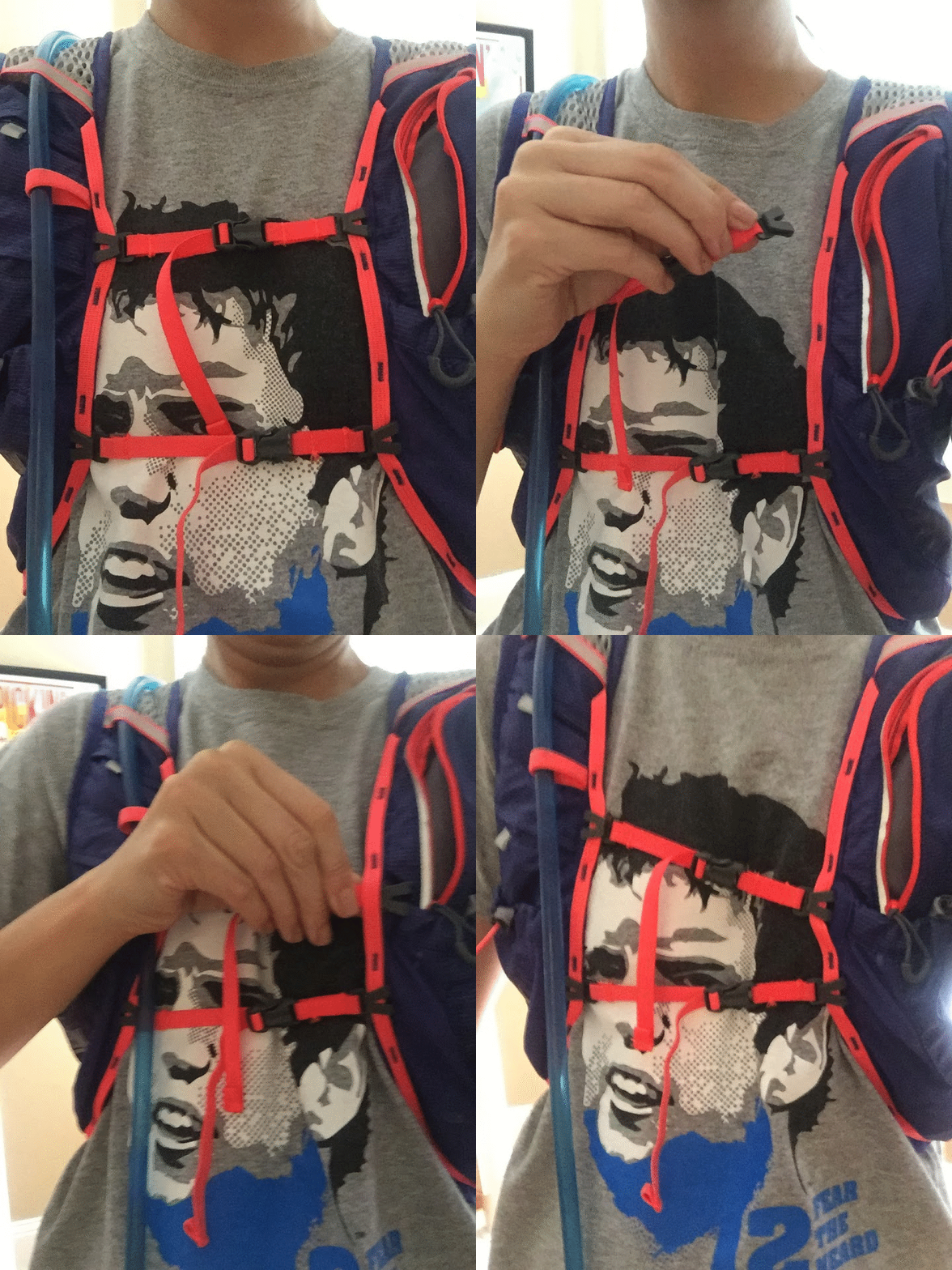
You can also adjust the placement of the sternum straps themselves – they unclip and clip back in at multiple points along the pack. This was incredibly handy for me when I was breastfeeding. The original strap placement didn’t fit once I had breastfeeding-sized boobs, and fortunately I was able to customize the fit around my new body.
The entire pack is mesh with large holes in it, which doesn’t trap heat and keeps my comfortable year-round, whether I’m running in 90 degrees or 20 (lol that’s rare, I totally wait for it to be warmer).
The older model (I bought mine in 2016) did have an issue with the side straps – they didn’t stay in place when I ran. I “fixed” this by tying knots in them so they wouldn’t loosen up while I ran. Fortunately, the new model appears to have fixed this or at least worked on it; no recent reviews mention that issue and the keeper seems sturdier.
Camelbak Circuit Water Storage
A drawback of the Camelbak vest is that the reservoir is kind of awful. Which is weird, because isn’t hydration, like, their thing? I wrote an entire blog comparing reservoirs, but the short version is that Camelbak’s doesn’t actually fit 1.5 liters and the tube is awkwardly thick and stiff.
Instead, I use a Platypus reservoir I already have from hiking, which fits fine into the vest. I’ve also tested the Osprey reservoir that came with my Dyna 6 (more on that vest momentarily) and it fits as well. This inconvenience was worth it to me because of the comfortable fit and low price tag (relative to other vests).
If you prefer to use soft flasks instead of a reservoir, that is possible with this vest but you will have to purchase them separately.
Camelbak Circuit Pack Storage
For being such a small pack, you can put a lot in it. With a full reservoir, I can still fit a thin shirt or extra snacks in the back part of the pack (it’s just all one big pocket). I love that the phone pocket is right up front, and that there are plenty of small compartments and deep pockets for snacks, chapstick, etc up front too.
Camelbak Circuit Wear and Tear
I’ve had the Camelbak Circuit vest for several years and use it at least once a week for runs ranging from 20 minutes to 2 hours. It hasn’t shown any signs of wear and tear, and when it did start to stink it was easy to throw in the washing machine on delicate and air dry.
Camelbak Circuit Pole Storage
If you want to store your hiking/trekking poles on your pack, to my knowledge, you can’t do this on the Camelbak Circuit (leave me a comment if I’m wrong!).
What other running vests did you try?
I did try on other very popular vests like the Nathan VaporAiress and Ultimate Direction’s Vesta collection (and the earlier Jenny collection) but they didn’t fit me very well.
I didn’t try on Salomon because it was too expensive and I didn’t want to risk falling in love with something I didn’t want to shell out that much money for. (Although, right now, one model is 25% off as of fall 2021, and REI members get an extra 20% off outlet items for the Labor Day Weekend sale).
I haven’t tried REI’s brand because it didn’t exist yet when I was shopping, but they do offer extended sizing! I also like that Ultimate Direction has ambassadors that are a range of body sizes.
Nathan VaporAiress
I immediately had to rule out the Nathan VaporAiress because it wasn’t adjustable and the smallest size is too big for me. The fabric is super stretchy and soft, and I wanted to like it SO badly because it feels so comfortable. But I needed something with more adjustability (I don’t think that’s actually a word but I’m going with it).
Nathan does seem to have fixed this issue as of the 2020 model, but it comes with a $150 price tag. I don’t remember them being that expensive in 2016, or I wouldn’t have tried it on in the first place. Nathan has a more basic model for under $100 called the QuickStart you could consider. I haven’t personally tried it, so I’m not sure of the pros and cons. REI is also having a 20% sale on Nathan products for Labor Day Weekend this year!
Ultimate Direction Vesta Collection
Ultimate Direction’s Vesta (fka Jenny) collection initially didn’t work for me because I didn’t like storing the little water bottles on top of my boobs. I also didn’t like that I couldn’t adjust the size without taking it off. Since 2016, when I was first shopping, Ultimate Direction has redesigned both of these features to be much better.
Ultra Vesta Overall Fit
I tried the Signature Series Ultra Vesta in 2018 when I was in the market for a larger pack. Ultimate Direction added a bungee in the small of your back that you pull to adjust the fit without taking it off. This was a feature that gave a lot of people chafing/blister problems (not me personally, but I read a LOT of reviews with that issue and also saw it come up frequently in the women’s trail running Facebook group I’m in). The entire vest also felt very rigid and structured compared to all the others.
Ultimate Direction has re-worked the bungee for the 5.0 that was released in 2020, but I haven’t tried that one out and can’t confirm if the fit has changed.
Even though I was skeptical, I loved the way the pack looked, and I’m not gonna lie, since a lot of ultra runners use it I wanted to look cool and have an Ultimate Direction pack. So I gave it a try.
Ultra Vesta Water Storage
Having water bottles on my chest took some getting used to, but the Ultra Vesta felt much less claustrophobic than the earlier Jenny models I tried on back in 2016. I do have small boobs and am generally a small person, so this may not be the same for everyone.
This vest is not designed for a reservoir; it’s designed for soft flask water bottles. You can make a reservoir work in it, but it doesn’t work that well. Plus, you have to already have a reservoir or be willing to purchase one since this vest only comes with bottles.
Ultra Vest Pack Storage
I loved how much the pack fit overall BUT I hated how it was laid out. That’s eventually what did it in. Ultimate Direction vest’s storage system was totally different than Camelbak in a way that didn’t work for me.
There isn’t a phone pocket on the front, and I didn’t like having to jam my phone into a pocket on the side of my rib cage. I kept thinking I would just get used to the new system and the learning curve would be worth it to have a vest that I could store hiking/trekking poles in.
Ultra Vest Pole Storage
Ultimate Direction is definitely the easiest on/off system for poles, but it only adds to the stuff piled on your chest and I found it extremely difficult to access other things on the front of the vest when I had poles attached.
A month went by and I still wasn’t used to how I had to organize my stuff. I ended up exchanging the Ultimate Direction vest for an Osprey Dyna 6. (For what it’s worth, my husband absolutely loves his Ultimate Direction vest, so try them on since your preferences may be different than mine!)
Osprey Dyna 6
The Osprey Dyna 6 was less expensive than Ultimate Direction Ultra Vesta, was designed to be used for a reservoir, and had a lot of the same features I already loved in the Camelbak (similar material, layout, and adjustability).
I didn’t try on a bigger Camelbak because I wanted to try vests on in person and REI didn’t carry Camelbak vests at the time. As I mentioned before, there is also a smaller Dyna 1.5 size that could also be great for lower mileage trail runners.
Osprey Dyna Overall Fit
I love the Dyna first and foremost for the fit and comfort. Like Camelbak, it has big, open mesh that’s soft and keeps you cool. I actually forgot to test out if the mesh was comfortable with a tank top before my race (I had been running in long sleeves leading up to it). But nearly three hours later I didn’t have any chafing!
The sternum straps and the rib cage straps are both adjustable and you can move the sternum straps up and down like on the Camelbak. There’s a little bit of a learning curve to the clip used for the sternum straps and for adjusting the rib cage straps on the go, but it wasn’t a dealbreaker for me because the vest was otherwise so comfortable.
HOWEVER, and this is a big however, Osprey has incredibly limited sizing. I am lucky/privileged because I have a smaller body that outdoor gear is typically designed for. Osprey vests only fit up to size Medium which is up to a 41-inch chest. This is really frustrating and a major oversight.
Osprey Dyna Water Storage
This vest is designed to be used with a reservoir. It comes with an Osprey Hydraulics 1.5L reservoir, which has (deservedly) received mixed reviews. When you are filling it for the first time, the factory seal is so tight at the top of the reservoir that you think you’re going to break it when you are trying to pull it apart. This fortunately only lasts one or two uses and then breaks in.
Other reviews have complained about leaks, and I have previously experienced leaks with older Osprey reservoirs. However, the one that came with my pack has never leaked and my partner’s decade-old Osprey reservoir has also never leaked. Buy through REI so you can always return it if this happens to you!
The most reservoir-friendly feature of the pack is the magnet on one of the sternum straps where you can clip the bite valve (the part you suck on to drink out of). The tube/hose of the reservoir itself is a little longer than I’d like, but it’s easy enough to just tuck it into the lower sternum strap so it doesn’t flop.
The drawback of the pack’s reservoir-friendly design is that the pockets up front are a little small for regular 500 mL soft flasks. I actually lost several on the trail because they fell out of the pockets (I couldn’t really get them all the way in in the first place).
I ended up buying one 250 mL soft flask from Osprey so I could bring some electrolytes in addition to regular water on my runs. This unfortunately no longer made the pack less expensive than Ultimate Direction.
Osprey Dyna Pack Storage
I can fit an incredible amount of stuff in the Dyna, too. I was training during the winter and loved all the room I had to pack an extra layer or stuff all the extra layers I had to rip off because I overdressed. (Learning how to dress for multiple-hour runs is hard!).
The pockets on the back of the pack are really thoughtfully organized with lots of little compartments to store small items like chapstick, a first aid kit, hand sanitizer, etc. There’s also multiple extra super-stretchy mesh pockets on the front of the vest to quickly stuff things into.
My only complaint is that the pockets up front can be a bit narrow. They are the perfect size for gels and gummies, but like I said earlier, you can’t fit standard size soft flasks in them. It’s also a very tight squeeze for waffles if you use those for nutrition. Honeystinger waffles are exactly the right width; apparently Gu waffles are a millimeter wider because I couldn’t get them into the pack without smashing the waffle.
Ospry Dyna Pole Storage
The pole storage isn’t quite as slick as Ultimate Direction. You have to take off your pack to get your poles on and off. But I have no illusions about needing to shave seconds off my race time, so I don’t mind that I’d need a few extra minutes to take them out or put them back. Having the poles on your back also lets you access everything in the front of your vest just as easily (this was an issue for me with the Ultimate Direction vest I tried).
On the left, there’s me with the Dyna pack with poles on the back. On the right is my partner in an Ultimate Direction vest with poles up front.
Osprey Dyna Wear and Tear
This pack held up great throughout the four months of half marathon training over the winter. I’ve brought it hiking dozens of times and also wear it for two- to three-hour runs once a week. It’s shown no signs of wear and tear and is easy to throw in the washing machine and air dry when it starts to stink.
The Bottom Line
The most important thing when picking out a running vest is that it fits you well. Going to a store in person right now is certainly trickly, but if you’re able to go to REI in person, try on all the vests in your price range and go with the one that’s most comfortable.
Most vests come in smaller models for lower mileage runners, which have the added benefit of being less expensive than a lot of classic brands you see ultra runners wearing. Look for 1.5L – 2L models if you don’t need to pack a ton of stuff with you.
One last thing. As always, you DO NOT need expensive gear to get outdoors. I can’t say that enough.
If you decide you do want to upgrade with some fancy gear or nicer clothes, I hope Outdoor Beginner will help you decide what might work for you with reviews from a beginner’s point of view. Now get out there and have fun!
As I ran down the paved rec path in Breckenridge a few weeks ago, I found myself suddenly extremely self-conscious of the fact that I was wearing a hydration vest. Long-distance trail runners typically wear a little backpack/vest that they can store water and snacks in when they go do things like run 20 miles up a mountain.
You may be thinking, “but Laura, are you really that hardcore?”
Listen. I had already (barely) justified the purchase of said vest by telling myself I would save it only for trail running because that was harder, I was further from civilization, etc etc. And that eventually I’d be running longer and totally need a vest.
But here I was, running two miles on a flat, paved trail in the middle of town. With my vest.
A grocery store (where I could get snacks and water) is just over that hill to the right.
In my mind, people wear vests on long trail runs because they’re really hard. And for me, running “short” distances is still really hard. So I wear the vest. I am more relaxed knowing I have plenty of water and emergency snacks, my phone is easily accessible for photos (obviously critical), and my hands are still free.
So I felt fine about rocking the vest, at least when I was around my fellow tourists at the resort I was staying at. But then I started seeing locals. And local runners. Or at least runners that looked like they could do a 10k (and probably a 100k too). And I started freaking out.
“They must think I look like such a douche running around town with a trail runner backpack”
“Since I’m talking walk breaks while wearing this endurance athlete vest people must think I’m an idiot”
“Everyone I pass is totally rolling their eyes at me and thinking I’m trying too hard”
I got back to the hotel, feeling like total garbage physically and mentally. I ran (and walked) for a grand total of 25 minutes and covered just over two miles (I totally lied and told my coworker I did a 5k because, you guessed it, I was embarrassed).
And then I realized that other people are too busy on their own runs to be worrying about what I’m wearing. And, they don’t know if I was on mile two or twenty. And they probably didn’t even care what I was wearing. And if they are judging me, that’s their problem.
Because you know what? Running is really effing hard, even “just” a few miles. Taking water and snacks with me (and not having to hold my cell phone) makes it infinitely easier.
If you don’t feel like you’re actually about to die, are you even a beginner runner?
Other people may not need or want water or snacks for a “short” run, but that’s what works for them. And wearing a vest “meant for” endurance athletes on my two-mile run is what works for me.
It’s easy to be plagued by worrying when you’re a beginner – how fast or slow you’re going, whether you have the right clothes, whether you look like you know what you’re doing, whether people can tell you’re just starting out. The list of things to be self-conscious about is never-ending, and it’s only magnified for women who are already worrying about a myriad of other things.
But the outdoors should be the place to escape all of that anxiety. Doctors are literally prescribing time in nature to people these days. So if you’re already lucky enough to be outside, try not to ruin it with negative self-talk.
Embrace that what you’re doing works for you. Wear the fancy gear, or don’t. Take the walk break. And remember that no one actually notices most of these things you’re so worried about.
What’s a beginner habit you’re self-conscious about? If you aren’t embarrassed by it anymore, what helped you overcome that anxiety?





 Outdoor Beginner